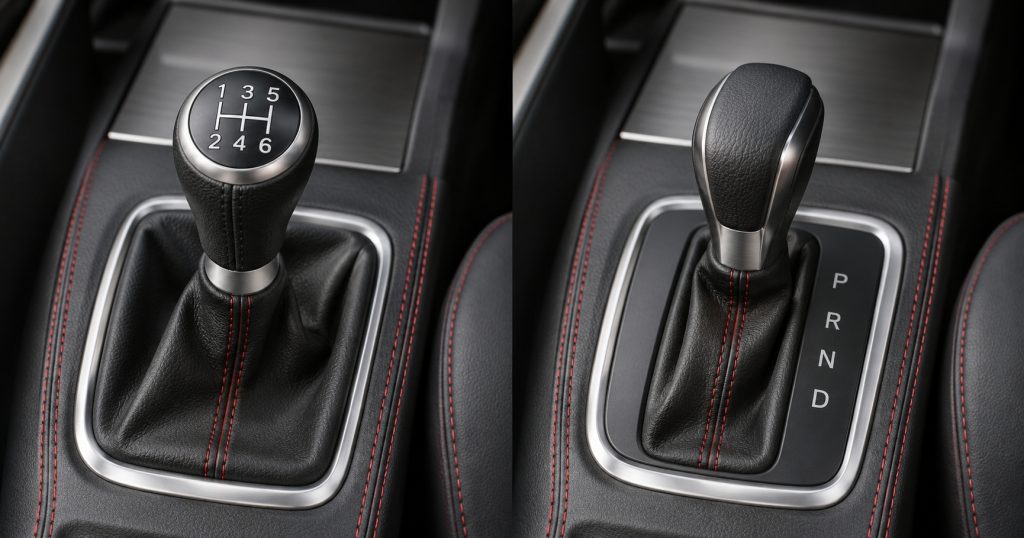
Learning in a manual gives you a licence for every car, while learning in an automatic means fewer controls to master but a licence that only covers automatic cars. That licence rule is the first thing to weigh up when you ask “should I learn manual or automatic?”
More Birmingham learners are choosing automatics than the national average. At the Kings Heath and Kingstanding test centres, more than a third of car tests in 2025/26 were taken in automatic cars, compared with 29.5% across Great Britain.
Select Drive teaches both, with automatic driving lessons in Birmingham at £39 an hour and manual lessons at £37 an hour (prices as of November 2026). The right choice depends on what you will drive after you pass, who you can practise with and how you feel about the clutch, not on which test sounds easier.
What each licence lets you drive
A manual car licence lets you drive both manual and automatic cars. An automatic car licence lets you drive automatic cars only, and DVLA marks the restriction on your licence with code 78, “restricted to vehicles with automatic transmission”.
The automatic restriction applies to every vehicle a car licence covers, not just cars. A car licence (category B) also covers vans up to 3,500kg, or up to 4,250kg for electric and hydrogen vans, so a driver who passed in an automatic can only drive automatic vans as well.
Two other types of car count as automatic for your test and your licence. A semi-automatic car, which has a gear lever but no clutch pedal, gives you the same automatic-only licence as a fully automatic car. Electric cars have no conventional gearbox or clutch, so DVSA treats them as automatics too.
Learning manual or automatic on Birmingham’s roads
A manual car asks you to control the clutch and choose the gears while you watch the road. An automatic changes gear for you and will not stall, which leaves more of your attention for mirrors, road position and other traffic. The difference shows up most on the kinds of roads the local test routes use.
Hills are where a manual demands the most. Dudley’s test routes are hilly, with narrow streets around Lower Gornal, and candidates pull up on the left several times during the test. Learners there tend to roll back a little on the hills. In a manual, each of those stops is a test of clutch control. An automatic takes the clutch out of it, though you still hold the car on a slope with the brakes.
Fast roads add a different kind of pressure. Kings Heath routes include the 70mph Hollywood Bypass, where learners have to match the speed of the traffic as they join. Wednesbury routes use the dual carriageways and large roundabouts of the Black Country Route. In a manual, you are working up through the gears while you check your mirrors and look for a gap.
“A lot of fails there are probably at the roundabouts, for observations or jumping lanes.”
Gurpreet Bhogal, Select Drive instructor, on the Kings Heath test routes
Observation and lane discipline faults at roundabouts happen in either car, so practising the roads you will be tested on matters whichever gearbox you choose.
Manual and automatic pass rates at Birmingham test centres
Automatic driving tests have a lower pass rate than manual tests, both across Great Britain and at all four Birmingham-area test centres Select Drive uses. In 2025/26, 44.6% of automatic tests in Great Britain were passes, compared with 52.3% of manual tests.
| Test centre | Car tests taken | Share taken in automatics | Automatic pass rate | Manual pass rate |
|---|---|---|---|---|
| Kings Heath | 9,072 | 35.2% | 44.7% | 47.8% |
| Kingstanding | 16,133 | 37.3% | 45.3% | 50.5% |
| Dudley | 13,721 | 29.7% | 41.5% | 46.8% |
| Wednesbury | 7,508 | 32.9% | 30.2% | 37.3% |
| Great Britain | 1,998,621 | 29.5% | 44.6% | 52.3% |
Source: DVSA car driving test data, April 2025 to March 2026. Manual figures are all car tests minus automatic tests.
The pass rate gap is not new. Automatic tests have passed less often than manual tests in every year of DVSA’s figures since 2007/08, even as the share of tests taken in automatics grew from about 4% in 2007/08 to 29.5% in 2025/26.
The size of the gap varies between local centres. At Kings Heath, the manual and automatic pass rates are 3.1 percentage points apart. Wednesbury has the widest gap of the four, at just over 7 percentage points, and the lowest pass rates overall.
Pass rates describe the people taking each test, not how hard each car is to drive. The DVSA figures do not record how many lessons each candidate had or why they chose an automatic. A lower automatic pass rate does not mean an automatic would make you less likely to pass.
Practising with family: check their licence first
Anyone who supervises your private practice must hold the right licence for the car you are learning in. A supervisor must be over 21 and have held a full licence for three years. They must also be qualified to drive the type of vehicle, so they need a manual car licence to supervise you in a manual car.
The supervision rule catches families out. If the only person who can take you out between lessons passed in an automatic, they cannot supervise you in a manual, and all of your manual practice will have to be paid lessons. A parent with a manual licence can supervise you in either car.
Driving without the right supervision can mean a fine of up to £1,000 and up to six penalty points on your provisional licence. You also need insurance that covers you as a learner driver, and you cannot practise on the motorway with family or friends. The full rules are on GOV.UK’s page on practising with family or friends.
Manual vs automatic side by side
| Manual | Automatic | |
|---|---|---|
| What you can drive after passing | Manual and automatic cars | Automatic cars only (code 78) |
| Pedals and gears | Three pedals, including the clutch, and a gear lever | Two pedals, no clutch |
| Lesson price at Select Drive | £37 an hour | £39 an hour |
| Driving test fee | £62 weekdays, £75 evenings, weekends and bank holidays | £62 weekdays, £75 evenings, weekends and bank holidays |
| Pass rate, Great Britain 2025/26 | 52.3% | 44.6% |
| Who can supervise your practice | Someone with a manual licence | Someone with a manual or automatic licence |
| Average insurance premium (all ages) | £683 | £824 |
| Changing your mind later | Already covers both | Pass a manual test to upgrade |
Prices as of November 2026. Pass rates from DVSA. Insurance figures are Confused.com averages for comprehensive policies, March to May 2026.
Automatic lessons cost £2 an hour more at Select Drive, but many learners need fewer hours in an automatic, so the overall cost can end up close. The guide to how much driving lessons cost in Birmingham works through the totals for both.
On average, insurance costs more for an automatic once you pass, because automatic cars tend to cost more to buy and repair. The difference is bigger for younger drivers: Confused.com’s averages for drivers aged 21 to 24 were £1,920 for an automatic against £1,267 for a manual.
Can you switch to manual later?
You can upgrade an automatic licence to a manual one at any time by passing a driving test in a manual car. You do not need to take the theory test again or apply for a new provisional licence. While you practise in a manual, the usual learner rules apply, including L plates.
The upgrade test is booked differently from a first test. An upgrade test cannot be booked online: you book it by phone with DVSA on 0300 200 1122, Monday to Friday, 8am to 5pm. If you fail, you can carry on driving automatic cars.
The automatic licence rule has not changed in 2026. In August 2026 the AA suggested a shorter route: a conversion course of up to 10 manual lessons with a driving school, followed by a one-hour session that includes a formal assessment, instead of a full test. That is a proposal for the government to consider, not a new rule. As of November 2026, you still need to pass a manual driving test to add manual cars to your licence.
How to decide
The best choice is usually the car you will actually drive once you pass. These questions settle it for most learners:
- What will you drive after your test? If the family car or your first car will be a manual, learn in a manual. If you plan to buy a newer or electric car, an automatic licence may be all you need.
- Who will you practise with? If your supervisor only holds an automatic licence, manual practice will be limited to paid lessons.
- Could work need a manual? If a job might involve driving a manual van or a pool car, a manual licence keeps that open.
- How do you feel about the clutch? If gears and clutch control make you anxious, an automatic lets you focus on the road and build confidence first.
- Which test centre will you use? Hilly routes such as Dudley’s ask more of a manual driver’s clutch control.
- What is your budget? Automatic lessons cost £2 an hour more, and insurance after passing is usually higher.
Frequently asked questions
Is an automatic licence a full licence?
Yes. Passing your practical test in an automatic gives you a full car licence, restricted to automatic vehicles with code 78. An automatic licence works like any other full licence, except that it only covers automatic cars and vans.
Is it easier to learn in an automatic?
Most learners find an automatic easier to control, because there is no clutch, no gear changing and no stalling. Easier to drive does not mean easier to pass, though: in 2025/26, 44.6% of automatic tests in Great Britain were passes, against 52.3% of manual tests.
Is the driving test different in an automatic?
No. The practical driving test works in the same way in a manual or an automatic car, and the fee is the same: £62 on weekdays, or £75 for evenings, weekends and bank holidays. The only difference is the licence you get when you pass.
Is it worth getting a manual licence in 2026?
A manual licence is still worth having if you might drive older, borrowed, hired or work vehicles. From 2030, new cars that run only on petrol or diesel cannot be sold in the UK. From 2035, all new cars must be zero emission, and electric cars are automatic. Those dates only affect new car sales: used manual cars stay legal to buy and drive.
Can I switch from manual to automatic part way through my lessons?
Yes. The car you take your test in decides what your licence covers, so your lessons do not lock you in. If the clutch is holding you back, you can switch to an automatic part way through, but passing in the automatic gives you an automatic-only licence.
Pick the car you will drive after you pass
The choice between manual and automatic comes down to the licence you need, not the test that sounds easier. A manual licence keeps every car open. An automatic licence suits learners who will drive automatics and want fewer controls to master, and it can be upgraded later. Select Drive’s automatic driving lessons in Birmingham and manual driving lessons both run across Birmingham and the West Midlands in a premium fleet.