
Yes, you can pass your driving test in one week. There is no legal minimum number of lessons required before taking your practical test in the UK, and an intensive driving course can compress weeks or months of learning into five consecutive days. Whether a single week is realistic for you depends on your current experience level, whether you choose manual or automatic, and whether you can secure a practical test date at the end of your course.
Most learners searching for one-week courses want a straight answer. This post gives you that answer, then walks you through what an intensive week actually looks like day by day, so you can decide whether it is right for you.
What a one-week intensive driving course looks like, day by day
The DVSA says the average learner needs around 45 hours of professional instruction plus 22 hours of private practice before passing. A one-week intensive course typically packs 25 to 35 hours into five days. That is enough for many learners, but not all. Here is what a realistic week looks like.
Day one: assessment and vehicle basics. Your instructor assesses where you are. Complete beginners cover cockpit checks, moving off, stopping, steering, and gear changes. Learners with some experience skip ahead. Most intensive days run four to six hours with breaks built in. Trying to do more than six hours in a single day leads to fatigue, and fatigued learners do not retain skills.
Day two: junctions, roundabouts, and emerging. This is where most of the core driving skills come together. You practise T-junctions, crossroads, mini roundabouts, and larger multi-lane roundabouts. In Birmingham, that means real traffic on real roads from the start.
Day three: dual carriageways, independent driving, and manoeuvres. You build speed confidence on faster roads, practise the three possible test manoeuvres (parallel park, bay park, or pulling up on the right), and start driving longer routes without constant instructor direction. The DVSA tests 27 separate driving skills, and by day three you should be working through most of them.
Day four: mock test and weak spots. A full mock test under exam conditions. Your instructor identifies the two or three areas that need the most work and you spend the rest of the day drilling those. Common weak spots include observations at roundabouts, mirror checks before signalling, and positioning on narrow roads with parked cars.
Day five: final preparation and test. A short warm-up drive, then the practical test itself. The test lasts around 40 minutes and covers roughly 20 of the 27 DVSA skills. If your test is booked for this day, you take it. If not, read the section below on test booking.
That is the ideal version. In practice, the schedule flexes around you. Some learners reach mock test standard by day three. Others need the full five days before they feel confident with roundabouts. A good instructor adjusts the plan daily based on how you are progressing, not based on a fixed script.
Who passes in a week (and who should allow longer)
Not everyone is a good fit for a one-week course. Learners who pass in a week tend to share a few things in common.
Good candidates for one week: You have had some previous lessons or private practice. You are comfortable with basic car control (clutch, gears, steering) and mainly need to build road experience, test technique, and confidence. You can commit to four to six hours of focused driving per day without burning out.
Better suited to two weeks: You are a complete beginner with no prior driving experience. The DVSA’s 45-hour average exists for a reason. Cramming that into five days means seven to nine hours a day, which is too much for most people to absorb. A two-week intensive, or a semi-intensive course spread over three to four weeks, gives your brain time to process what you have learnt between sessions.
The readiness test that matters: Forget counting hours. The DVSA’s Ready to Pass? framework measures readiness across 27 driving skills, each at five levels of competence. You are test-ready when you consistently reach level five (independent, reflective driving) across all 27. Some learners get there in 25 hours. Others need 60. An intensive course does not change how many hours you need. It just puts those hours closer together.
If you are weighing up whether an intensive course suits your situation, we covered the full pros and cons in our guide to whether intensive driving courses are worth it.
The test booking reality nobody mentions
Here is the part most intensive driving schools leave out of their marketing. Even if you finish your lessons on Friday, your practical test might not be until three to six weeks later.
DVSA practical test waiting times vary by area and time of year. In busy regions, the next available slot can be weeks away. Some driving schools advertise “test included” in their intensive packages, but that usually means they search for short-notice cancellation slots on your behalf. It is not a guaranteed same-week test.
The practical reality for most learners booking a one-week intensive course in Birmingham looks like this: you complete your intensive week, then either wait for your pre-booked test date or check for cancellations daily using the official DVSA booking service. Some learners book their test weeks in advance and schedule the intensive course to finish just before the test date. That approach works well if you plan ahead.
The gap between finishing lessons and sitting the test is not wasted time. Use it for private practice with a family member or friend (they need to be over 21, have held a full licence for at least three years, and the car needs learner driver insurance). A few hours of independent practice between your intensive week and test day keeps the skills fresh.
One thing that is non-negotiable: your theory test must be passed before you can book the practical. If you have not passed your theory yet, get it done first. Do not plan your intensive week until the theory certificate is in hand.
Manual or automatic: which gives you the best chance in a week?
This is a question almost nobody on the internet answers properly, but it matters.
The DVSA’s 45-hour average is based on manual learners. Automatic learners typically need fewer hours, often in the range of 30 to 40 hours, because there is no clutch control or gear coordination to master. That difference makes a one-week pass significantly more achievable in an automatic car.
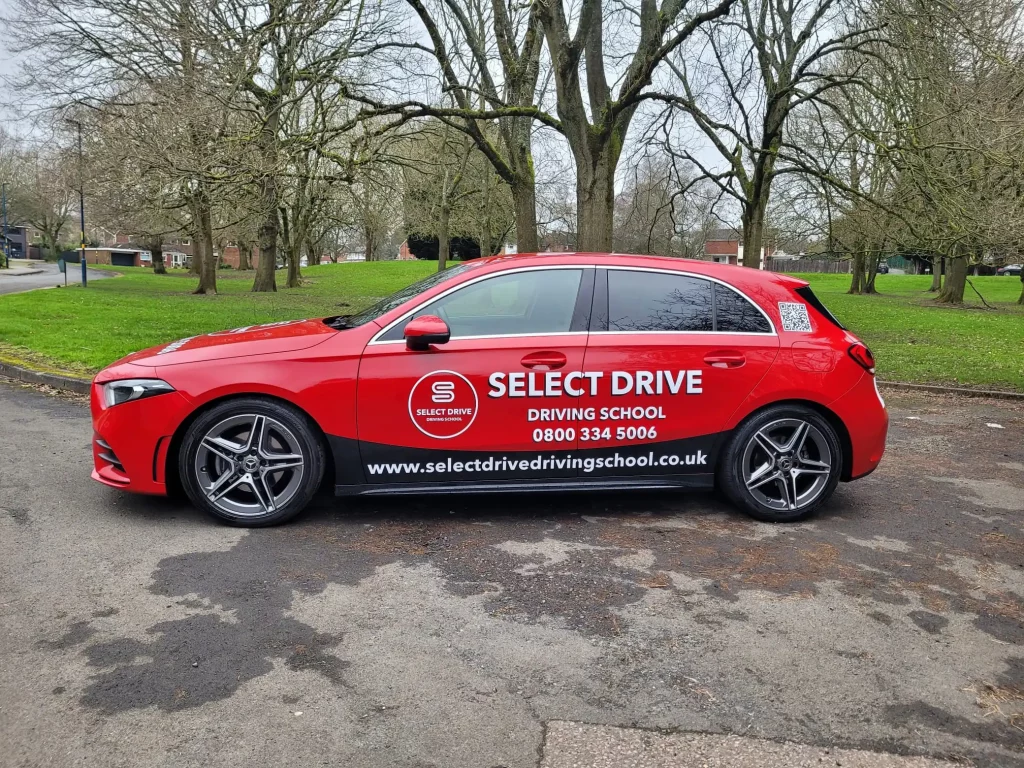
At Select Drive, manual learners drive the BMW 1 Series M Sport. Automatic learners drive the Mercedes-Benz A-Class AMG. Both are premium cars that handle well, respond predictably, and make the learning experience more comfortable than a basic training vehicle. If your main priority is passing quickly, choosing automatic lessons removes the steepest part of the learning curve and lets you focus entirely on road skills, observations, and test technique.
The trade-off is that passing in an automatic gives you an automatic-only licence. You would need to take a separate test later if you want to drive manual. For many learners, especially those who just need a licence for commuting, that trade-off is worth it.
What an intensive week costs
Most intensive driving schools sell fixed-price packages, typically starting around £1,000 for a one-week course according to the RAC. Select Drive does it differently. Instead of a package price, you pay per hour: £35 per hour for manual lessons in the BMW 1 Series M Sport, or £37 per hour for automatic lessons in the Mercedes-Benz A-Class AMG.
That means a 30-hour intensive week costs approximately £1,050 for manual or £1,110 for automatic. If you need fewer hours because you already have some experience, you pay less. If you need a few extra hours, you add them without buying an entirely new package.
Prices are as of May 2026. For the latest pricing and to discuss which course length suits your experience level, visit our intensive driving courses page.
What happens if you do not pass
Failing is not the end of your intensive investment. Around half of all learners in the UK do not pass their practical test first time. That is normal, not a disaster.
If you do not pass after an intensive week, the skills you built during those five days do not disappear. You book additional lessons to work on the specific faults from your test result, rebook the practical test, and try again. Most learners who fail after an intensive course need only a handful of extra hours to reach test standard on the second attempt.
Some driving schools advertise a “guaranteed pass,” but read the fine print. It usually means a free re-test or a few free top-up lessons, not a literal guarantee that you will pass. No instructor can guarantee a pass, and any school that claims otherwise should raise a red flag.
You can read what real learners say about their experience with Select Drive on our reviews page, including learners who passed through intensive courses.
Is a one-week course right for you?
A one-week intensive driving course is a realistic option if you already have some driving experience, can commit to full days behind the wheel, and are prepared to plan around DVSA test availability. For complete beginners, two weeks or a semi-intensive schedule is usually a better fit.
The best way to find out is to have a conversation with an instructor who can assess where you are and recommend the right course length. Select Drive’s intensive driving courses are built around you, not around a fixed package, so you only pay for the hours you actually need.
Frequently asked questions
Can you realistically pass your driving test in one week?
Yes, many learners pass in one week through an intensive driving course. It is most realistic if you have some prior driving experience and can commit to four to six hours of lessons per day. Complete beginners usually need two weeks or longer to cover the full DVSA syllabus comfortably.
How many hours a day do you drive on an intensive course?
Most intensive courses run four to six hours per day, with breaks between sessions. Driving for longer than six hours leads to mental fatigue, which reduces how much you retain. Quality of practice matters more than raw hours.
Do you need to have passed your theory test before an intensive course?
Yes. You cannot book your practical driving test until your theory test is passed. Get your theory done before booking your intensive week, not during it.
What happens if you fail your driving test after an intensive course?
You book extra lessons to address the specific faults from your test, then rebook the practical test. The skills from your intensive week stay with you. Most learners only need a few additional hours before passing on the second attempt.